Breaking: V8's Turbofan Compiler Abandons Sea of Nodes
In a major architectural overhaul, Google's V8 JavaScript engine is moving away from the Sea of Nodes (SoN) intermediate representation in its Turbofan compiler, opting instead for a more traditional Control-Flow Graph (CFG) IR called Turboshaft. This transition, underway for nearly three years, is now nearly complete, with the entire JavaScript backend and the WebAssembly pipeline running on Turboshaft. Two remaining Sea of Nodes components—the builtin pipeline and the JavaScript frontend—are being phased out in favor of Turboshaft and Maglev, a separate CFG-based IR.
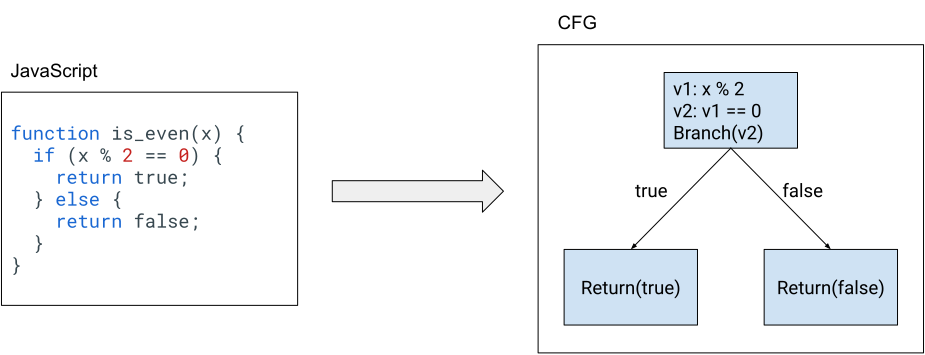
'The Sea of Nodes served us well for over a decade, but we realized it introduced unnecessary complexity that slowed development and debugging,' said a senior V8 engineer. 'Turboshaft gives us the simplicity of a CFG while still enabling high-performance optimizations.'
Background: The Rise and Fall of Sea of Nodes
The Sea of Nodes was introduced 12 years ago in 2013 as a radical rethinking of V8's optimizing compiler Crankshaft. Crankshaft, built on a CFG, had become a maintenance nightmare: it required hand-written assembly code for each new IR operator across four architectures (x64, ia32, arm, arm64), struggled with asm.js optimization, and could not introduce control flow during lowering—limiting transformations like handling string addition. It also lacked try-catch support and suffered from severe performance cliffs, often causing 100x slowdowns when hitting edge cases.
Sea of Nodes addressed some of these issues by allowing flexible reordering and merging of operations, but it introduced a steep learning curve and made the compiler harder to maintain. Over time, the V8 team concluded that a simpler CFG approach could deliver the same runtime performance with lower engineering cost.
What This Means for JavaScript Performance
The shift to Turboshaft is expected to improve compiler stability and reduce bugs, leading more predictable optimization behavior for JavaScript developers. 'Developers will see fewer deoptimization loops and more consistent performance across different code patterns,' explained the engineer. 'The move also simplifies adding new JavaScript features, as Turboshaft's CFG is easier to extend.'
For the WebAssembly community, the full adoption of Turboshaft across the pipeline means faster compilation and better integration with JavaScript. The remaining Sea of Nodes parts—the builtin pipeline (being rewritten in Turboshaft) and the JavaScript frontend (being replaced by Maglev)—are targeted for completion within the next year.
Related: See Background and What This Means for deeper context.